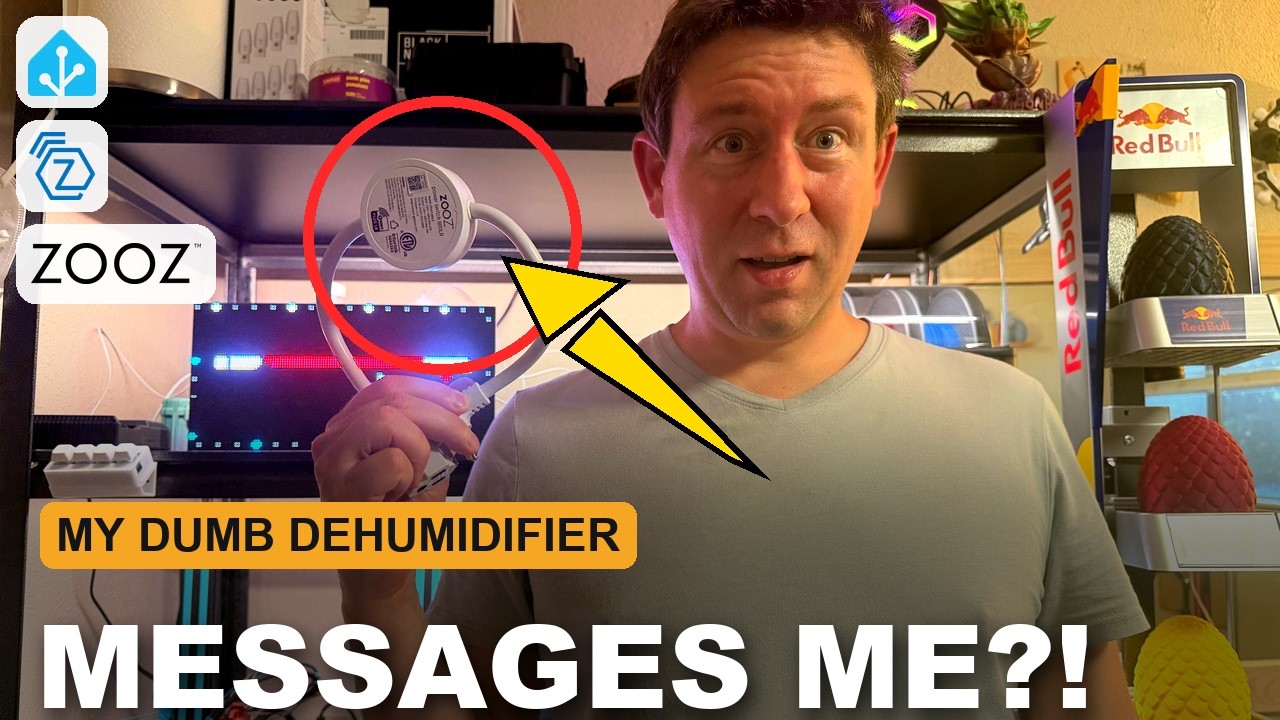
My dehumidifier is as dumb as appliances get. No wifi, no app, no subscription. When the tank fills up it shuts itself off and just sits there, silent, while the humidity it was supposed to be pulling out of the air creeps right back. By the time I noticed, it had usually been off for a day or two.
It notifies me now. The whole trick is a fifty dollar smart plug and one free Home Assistant automation, and I made a full video walking through it:
Watch the watts
The dehumidifier doesn’t have to be smart. Its power cord already tells the whole story.
While it’s running, the compressor pulls a few hundred watts and cycles up and down. When the float switch trips on a full tank, the whole unit shuts down and the power draw drops to basically zero, and it stays there. So I don’t need the appliance to report anything. I just need to measure the power going into it and watch for that drop.
That’s exactly what an energy-monitoring smart plug does.
Why the Zooz ZEN15
I used the Zooz ZEN15 800LR. It’s rated for 15 amps, which matters because dehumidifiers, fridges, sump pumps, anything with a compressor is a hard load that will cook a flimsy plug. This is the plug Zooz builds for exactly these appliances, and it has real energy monitoring, so it reports the actual watts flowing through it. That number is the entire project.
It’s also Z-Wave Long Range. Regular Z-Wave hops messages device to device through the mesh; Long Range talks straight to the hub with a much stronger signal, which is perfect for a dehumidifier sitting in a basement, garage, or crawlspace away from everything else.
Scan the QR code first, then plug it in
This is the part that tripped me up, so do it in this order.
The ZEN15 uses SmartStart, which means you scan a QR code instead of doing the old button-press pairing dance. Scan the code on the device itself, not the box. The box gets thrown out, and the sticker on the plug is guaranteed to match the unit in your hand.
The order matters: scan the QR code first, then plug the device in. Scanning only adds the plug to a provisioning list. It actually joins the network when it powers on and announces itself, and those announcements come in intervals, so it can sit there for a minute or two looking like nothing is happening. Mine took about a minute and a half. If it stalls longer than that, pull the plug for ten seconds and plug it back in to restart the join.
When you add it, choose Long Range when prompted, and rename the device to something obvious like “Dehumidifier” right away. Home Assistant names every sensor after the device, so getting the name right up front keeps everything readable later.
One setting worth changing
While you’re in the device’s configuration page, find State After Power Failure and set it to On.
The default can leave the plug off after a power blip, and a dehumidifier that silently stays off after an outage is the exact problem this whole project exists to prevent. Set it to always come back on. These Z-Wave configuration entities are disabled by default in Home Assistant, so you reach this one from the device page under Configure rather than in the normal entity list.
It’s also worth checking for a firmware update right after pairing. Do that once it’s joined, not in the middle of setup.
The automation
Once the plug is reporting watts, the rest is one short automation. If the power draw stays under 20 watts for 5 minutes, the tank is full, so send a notification.
alias: Dehumidifier tank full notification
description: >-
  Notifies when the dehumidifier plug's power drops near zero for 5 minutes,
  which usually means the tank is full and needs to be dumped.
triggers:
  - trigger: numeric_state
    entity_id: sensor.YOUR_PLUG_electric_consumption_w
    below: 20
    for:
      minutes: 5
actions:
  - action: notify.mobile_app_YOUR_PHONE
    data:
      title: Dehumidifier
      message: It is time to dump the dehumidifier
mode: single
Swap in your own plug’s power sensor and your own phone’s notify service. If you have the Home Assistant companion app installed, your phone is already in that list.
The 5-minute hold matters. Without it you’d get pinged every time the compressor takes a short breather between cycles. Making the power stay under 20 watts for five full minutes is what separates “the tank is full” from “the compressor is resting.” Leave it at five.
The caveat
This fires any time the power drops, not only when the tank is full. If someone turns the unit off, or some models shut down when they hit their target humidity, you’ll get the same notification. In practice I’m fine with that. The message says the tank may need dumping, and a thirty second false alarm beats a flooded corner every time.
The same trick works on other appliances
Power monitoring plus a numeric-state trigger means any dumb appliance can report in. The washer finished. The freezer in the garage stopped running. The sump pump just kicked on at three in the morning. Same plug, same trigger, different threshold.